kapa.ai vs Fin (Intercom Fin): Best AI Agent for Technical Docs
Written by
Anton Malling
•
Updated
Short answer
Fin is a customer-service AI agent built to deflect broad support conversations across many channels. kapa.ai is a technical knowledge platform that answers questions from your docs, code, and product knowledge, used in production by 200+ technical companies including Grafana, Nokia, and n8n. The choice comes down to one question: how technical are the questions you need answered, and where do they come from?
The bigger difference is scope. Fin is a support agent that lives in the support inbox. kapa.ai is an organization-wide technical knowledge layer: one knowledge base that answers for your users, your employees, and your own product's AI features.
Naming note: in May 2026 Intercom renamed the company to Fin after its flagship AI agent. Throughout this article, "Fin" refers to the AI agent.
Updated note: Fin has been acquired by Salesforce - it's still unknown how the product might change
At a glance: kapa.ai vs Fin
Legend: ✅ built for this | ⚠️ possible but not the focus | ❌ not offered
Capability | kapa.ai | Fin |
|---|---|---|
Technical answer accuracy (docs, code, APIs) | ✅ Purpose-built RAG | ⚠️ General-purpose |
Source citations + explicit "I don't know" | ✅ | ⚠️ |
Code as a knowledge source (GitHub, cites file + line) | ✅ | ❌ |
Multi-product / multi-version knowledge | ✅ Source groups + separate instances | ⚠️ |
Knowledge sources | ✅ 40+ technical connectors | ⚠️ Help center + past conversations |
Customer-facing deployment (docs widget, community, support form) | ✅ | ✅ |
Omnichannel support (email, WhatsApp, SMS, voice) | ❌ Not its job | ✅ |
✅ | ❌ External only | |
Power your own product's AI (Retrieval API, SDK, hosted MCP) | ✅ | ❌ It is the packaged agent |
Take actions in your systems | ✅ Agent SDK + custom tools | ✅ Procedures / actions |
Analytics | ✅ Coverage gaps, top questions, source analytics, CSAT | ⚠️ Resolution / support metrics |
Pricing model | Platform fee + answer volume, 14-day free trial | ~$0.99 per resolution + support seats |
Best fit | Technical products: dev tools, infra, hardware, semiconductors, technical SaaS | General customer-service orgs |
What each one is built for
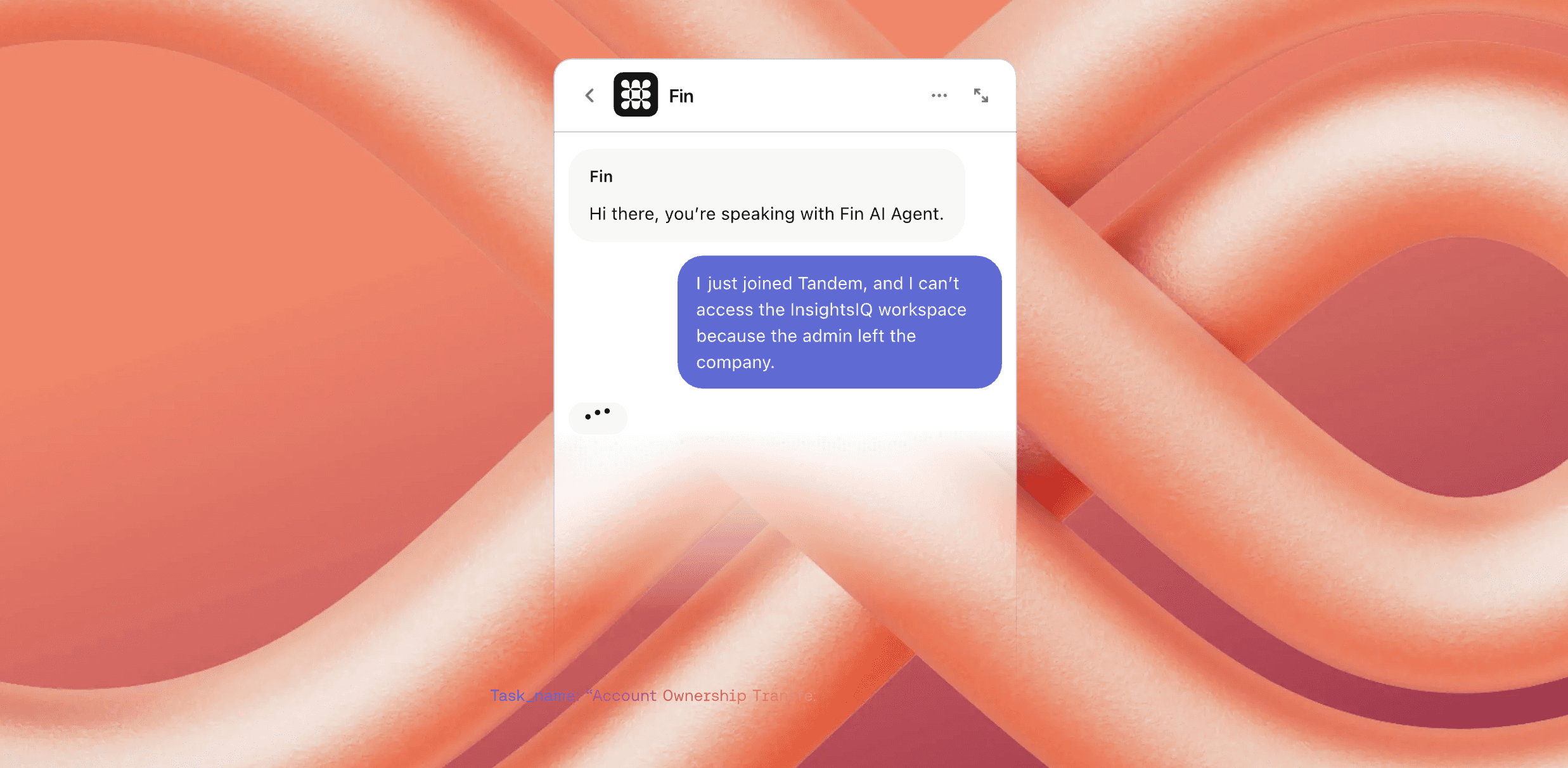
Fin is a customer-service agent. It resolves support conversations end to end, holds context across a multi-turn chat, escalates to a human when it should, and can take actions through configured procedures. It runs across chat, email, WhatsApp, SMS, social, and voice, and pairs with major helpdesks without a forced migration. For a support organization deflecting a broad mix of customer questions, Fin is a strong, mature product.
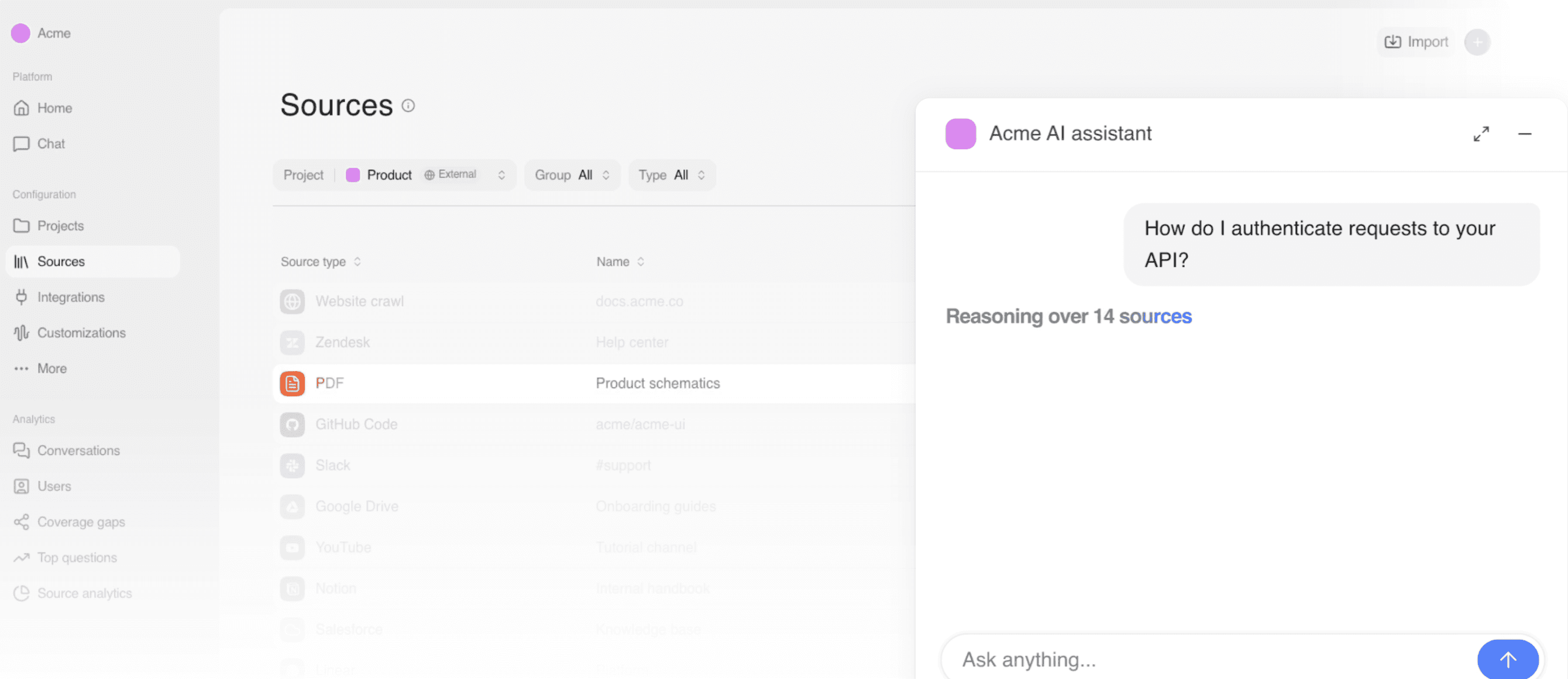
kapa.ai is built for a narrower, deeper problem solved organization-wide: getting accurate technical answers to everyone who needs them, and telling docs and product teams what to fix. From one synced knowledge base it answers on your docs site, inside developer communities on Slack and Discord, through a support form deflector that resolves around 40% of tickets before they are filed, as a copilot for your support team, and as an internal assistant for the solutions engineers, CS, and support staff who field technical questions all day.
This is where kapa.ai covers ground Fin does not. Fin is customer-facing only, the inverse of an internal tool like Glean. kapa.ai serves your users, your employees, and your product's own AI features from the same index.
Does Fin work for technical documentation and developer questions?
Fin handles broad support well, but general-purpose agents resolve a smaller share of complex, product-specific technical questions. Fin's own site cites an average resolution rate around 76% across 8,000+ customers, but real-world figures vary widely: simple, FAQ-heavy support can clear 70%, while complex B2B support with technical edge cases tends to sit closer to 35%. The harder and more specialized the question, the more a general support agent struggles.
kapa.ai is engineered for that hard end:
Model-agnostic accuracy. Draws on OpenAI, Anthropic, Cohere, and Voyage plus in-house models, selected per use case, with in-house evals for factuality, uncertainty, and citations.
Every answer cites its sources, and an explicit "I don't know" guardrail means kapa declines rather than inventing an answer.
Code as a source. kapa ingests your GitHub repositories and cites the specific file and line, answering questions docs were never written to cover ("how does the retry logic work?"). This is a source type Fin does not offer.
As one proof point, Airbyte uses kapa to handle roughly 80% of its developer questions, the equivalent of about two full-time support engineers.
More than a chatbot: kapa.ai as your product's knowledge layer
The deepest difference is what kapa.ai becomes once your knowledge is indexed: infrastructure you build into your own product. kapa exposes the same technical retrieval through a Retrieval API, SDK, and hosted MCP server, so the agents you already ship (in-product assistants, support copilots, and coding agents like Claude, Cursor, and Codex) can call kapa as a single retrieval tool.
When an agent hits a question its own tools cannot answer ("how do I enable SSO?", "why did my deploy fail?"), it falls back to your product knowledge and answers with a citation instead of guessing. On real product questions, kapa's agentic retrieval returns the right source roughly twice as often as general web-search APIs or a DIY RAG pipeline. Teams like Port, Airbyte, Matillion, and Nordic Semiconductor build product copilots and coding assistants on it.
This line does not really exist for Fin. Fin is the finished support agent your customer talks to; it can consume knowledge over MCP but does not expose retrieval for you to build on. kapa.ai is both an answer experience you deploy and a knowledge layer you embed.
Deployment and knowledge sources
Fin ingests help center articles, past support conversations, and connected knowledge, and is fastest to value when you want the agent wired into the same support inbox, workflows, and human handoff your team already uses.
kapa.ai pulls from the sources technical knowledge scatters across: documentation sites, GitHub code, Confluence, community forums, chat platforms, and resolved tickets, through 40+ connectors with scheduled refreshes. Before anything is ingested you review it in a pull-request-style step, so you control what the assistant learns from.
Pricing: read the model carefully
Fin charges about $0.99 per resolution plus support-platform seats, so the bill scales directly with volume. kapa.ai is a platform fee plus answer volume, starting with a 14-day free trial.
The trap to avoid is comparing kapa.ai's subscription total against Fin's marginal per-answer price: that compares a total to a marginal and misses what the subscription includes. Docs intelligence, coverage-gap analytics, and voice-of-customer insight never show up in a per-answer figure but are all included in the kapa.ai platform. For a high-traffic docs assistant or a busy developer community, a predictable platform fee also changes the economics at scale.
Can you use kapa.ai and Fin together?
Yes, and it is a common pattern: run kapa.ai as the knowledge layer behind Fin. Fin is good at handling the conversation, deciding when to call a tool, and stitching answers back into the chat. What it lacks out of the box is deep knowledge of your specific product, which is exactly what kapa indexes.
You can expose your kapa project over MCP and register it inside Fin, so Fin falls back to semantic search across your knowledge base with citations, or wire kapa into Fin as a co-pilot that drafts cited replies for human agents. Fin owns orchestration and channels; kapa.ai supplies accurate, cited product knowledge.
When to choose kapa.ai vs Fin
Choose Fin if you are a support or customer-service team, your question mix is broad and largely non-technical, you need omnichannel coverage including voice, and you prefer to pay per resolution.
Choose kapa.ai if your product is technically complex (developer tools, APIs, infrastructure, hardware, semiconductors, or technical SaaS), your questions come from developers and span docs, code, and API references, you want one knowledge base to serve your users, employees, and your own product's AI features, and accuracy with citations and honest "I don't know" behavior is non-negotiable.
These are not mutually exclusive. Many companies run a general support agent for front-line service and kapa.ai for the technical and developer-facing questions a general agent answers least reliably, sometimes with kapa.ai powering that support agent's knowledge directly.
What is the difference between kapa.ai and Intercom Fin?
Fin is a customer-service AI agent built to deflect general support conversations across channels, while kapa.ai is a technical knowledge platform purpose-built for docs, code, and developer questions. Put simply, Fin is support deflection and kapa.ai is an organization-wide technical knowledge layer for your users, employees, and your own product.
Is Intercom Fin good for technical documentation and developer questions?
Fin handles broad customer support well, but on complex, product-specific technical questions general-purpose support agents tend to resolve a smaller share. kapa.ai is tuned for that hard, developer-facing end, with source citations on every answer, an explicit "I don't know" guardrail, and the ability to answer from your source code.
How does kapa.ai pricing compare to Intercom Fin?
Fin charges about $0.99 per resolved outcome plus support-platform seats, so the bill scales directly with volume. kapa.ai is a platform fee plus answer volume with a 14-day free trial, and it includes docs analytics and coverage-gap insight that a per-answer price does not capture. Comparing kapa.ai's platform total to Fin's marginal per-answer price is misleading because it weighs a total against a marginal.
Can I use kapa.ai together with Fin?
Yes. You can run kapa.ai as the knowledge layer behind Fin by exposing your kapa project over MCP or wiring it in as a co-pilot, so Fin handles the conversation while kapa.ai supplies accurate, cited product knowledge.
Can kapa.ai answer questions from my source code, and can Fin?
kapa.ai can ingest your GitHub repositories and cite the specific file and line in its answers, which lets it answer implementation questions documentation does not cover. Fin does not offer source code as a knowledge source, so this is a capability specific to kapa.ai.
Can kapa.ai power my own product's AI agent or coding assistant?
Yes. kapa.ai exposes its technical retrieval through a Retrieval API, SDK, and hosted MCP server, so your in-product agents and coding assistants like Claude, Cursor, and Codex can call it as a tool and answer product questions with citations. Fin is the packaged support agent itself and does not expose retrieval for you to build on.
TRUSTED BY 200+ INDUSTRY-LEADING ENTERPRISES WITH COMPLEX PRODUCTS
- Silicon LabsAsk anything...
- LogitechAsk anything...
- n8nAsk anything...
- monday.comAsk anything...


