FOR SEMICONDUCTOR
Kapa puts an agent on top of your datasheets, compatibility matrices, and device specifications. It pulls the exact register, spec, or config out of thousands of pages, grounded only in your sources
and citing every answer.


how it works
Connect your sources
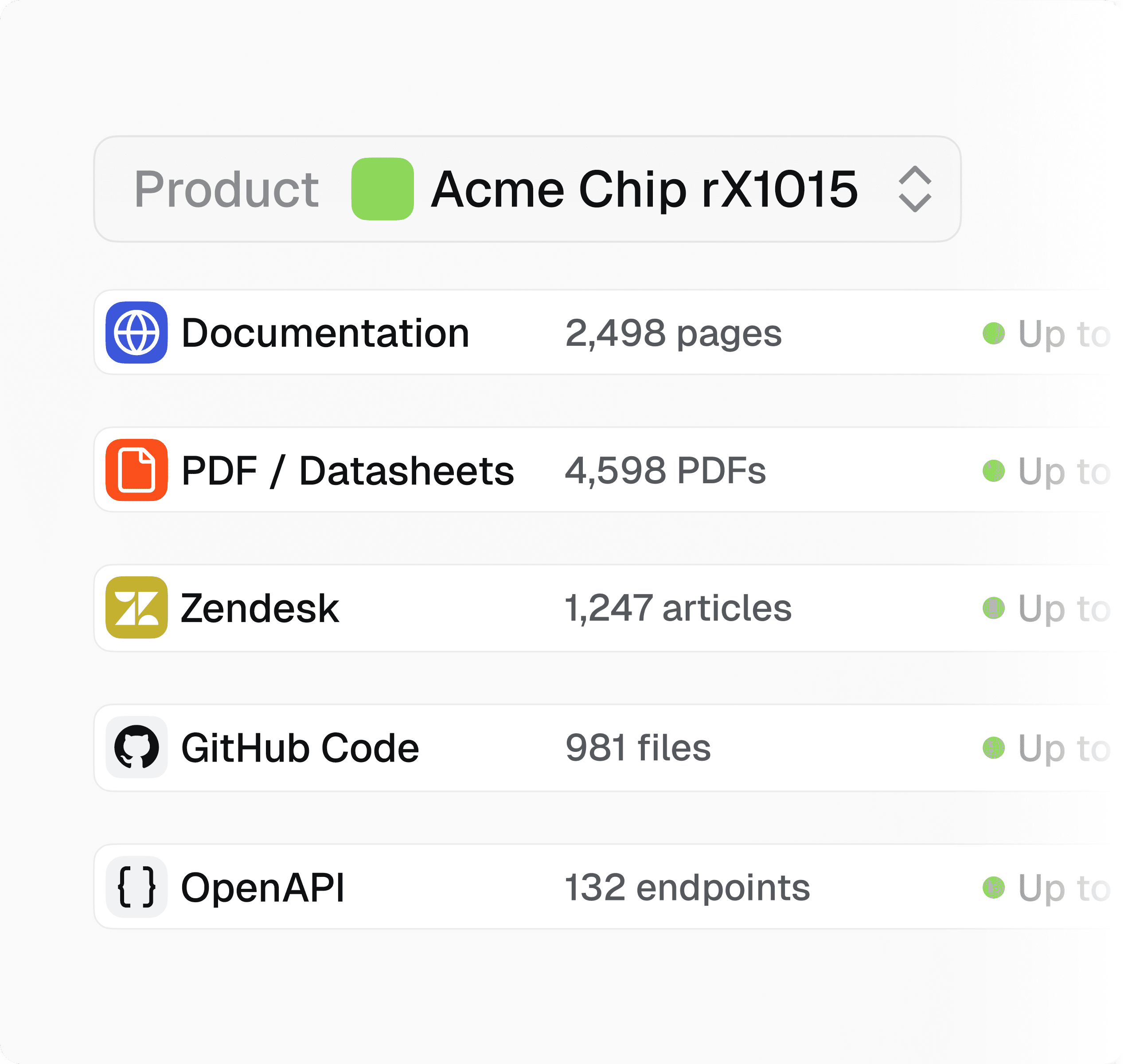
Connect 30+ sources: help centers, GitHub code, wikis, PDFs, and SDKs.
Customize your agent
Set brand color, logo, font, layout, MCP installation link, and much more.
Deploy in 5 minutes
Copy and paste a code snippet and go live with just one click.
The agent trusted to answer technical questions about semiconductors for millions of engineers, every day


“We have a Kapa agent live on our website, which addresses thousands of customer queries daily and helps users navigate our extensive product documentation.”

Radhika Chennakeshavula, CIO


Try Kapa with your technical content
Test and evaluate Kapa for free
Go live in less than 7 days
SOC 2 Type II & GDPR compliant
Why is Kapa.ai a good fit for semiconductor documentation specifically?
Semiconductor knowledge lives in dense, high-stakes material like datasheets, reference manuals, application notes, errata, and SDKs, where the right answer is often a single register value, pin configuration, or peripheral setting buried in thousands of pages. Kapa puts an agent on top of exactly these sources and retrieves the precise spec an engineer needs rather than a vague summary. Answers are grounded only in your documentation, which matters when an incorrect timing parameter or voltage spec can derail a design. This lets application engineers and developer support teams resolve detailed questions in seconds instead of manually paging through PDFs. Kapa is already trusted by semiconductor companies such as Silicon Labs and Nordic Semiconductor, alongside 200+ technical companies overall.
What knowledge sources can Kapa.ai ingest from our engineering organization?
Kapa connects to 30+ source types, so you can bring together the full picture of your product knowledge in one agent. This includes documentation portals and help centers via web crawling, technical PDFs such as datasheets and reference manuals, GitHub code and pull requests, SDKs, wikis, and knowledge bases. PDFs with an embedded text layer are supported directly, and Kapa can also pull linked files like PDFs found during a crawl. You can connect public sources as well as internal repositories, and combine them so engineers get answers that span code, specs, and prose. Sources stay in sync so the agent reflects your latest published material.
How does Kapa.ai keep answers accurate for one specific part number or silicon revision?
Kapa uses source groups, which are labels you assign to data sources so you can organize them by product family, part number, or silicon revision. When you deploy an agent or widget, you can scope it to only the relevant groups, so an engineer working on one device never receives an answer meant for a different part or version. This directly addresses the common problem where indexing multiple similar products or doc versions produces mixed citations and lower answer quality. Source groups support a two-level hierarchy with a Global group whose sources are inherited everywhere, which is useful for shared material like common peripherals or company-wide notes. The result is precise, correctly scoped answers even across a broad and versioned product portfolio.
How do we trust the answers, and can engineers verify them against the source?
Kapa is built on retrieval-augmented generation, so every answer is grounded in specific sections of your own documentation rather than generated from open-ended model knowledge, which minimizes hallucinations. Each answer includes clickable citations that link back to the exact source passages, so an engineer can confirm a register definition or spec in the original datasheet before acting on it. This verifiability is essential in semiconductor work, where answers feed directly into hardware and firmware decisions. Kapa also provides source analytics that show which parts of your documentation are referenced most often, helping your team see coverage and find gaps. Because accuracy depends partly on source quality, well-structured documentation further improves the precision of responses.
How does Kapa.ai protect our proprietary IP and customer data?
Kapa is SOC 2 Type II certified and GDPR compliant, and you can review its security posture and request compliance documents through its Trust Center. Your data is encrypted both in transit and at rest, which matters when ingesting confidential reference manuals, errata, and pre-release datasheets. Kapa signs opt-out agreements with its LLM providers so your proprietary content is not used to train their models. For end-user data, PII protection can remove or substitute sensitive information so it is neither stored nor surfaced in responses. You can also deploy agents behind a login, keeping confidential documentation restricted to authenticated engineers and customers rather than the public.