connect

Connect every source of technical knowledge

Securely connect Kapa to your documentation, code, support tool and more. We index it all and keep answers accurate as your knowledge changes over time.

Trusted by OpenAI, n8n, Netlify and 200+ companies

Trusted by OpenAI, n8n, Netlify and 200+ companies

how it works

Ingest your knowledge, and Kapa keeps it up-to-date

how it works

Ingest your knowledge, and Kapa keeps it up-to-date

Connect your sources

Connect 30+ sources: help centers, GitHub code, wikis, PDFs, and SDKs.

Sync in real-time

Update a source or ship a new version and Kapa re-indexes automatically.

Close documentation gaps

See the questions Kapa couldn't answer, and what to write next.

capabilities

Built for scale and complexity

capabilities

Built for scale and complexity

Versions every product

Answers stay scoped to the right product and version.

Supports complex data types and images

Parses PDFs, images, and code, not just text.
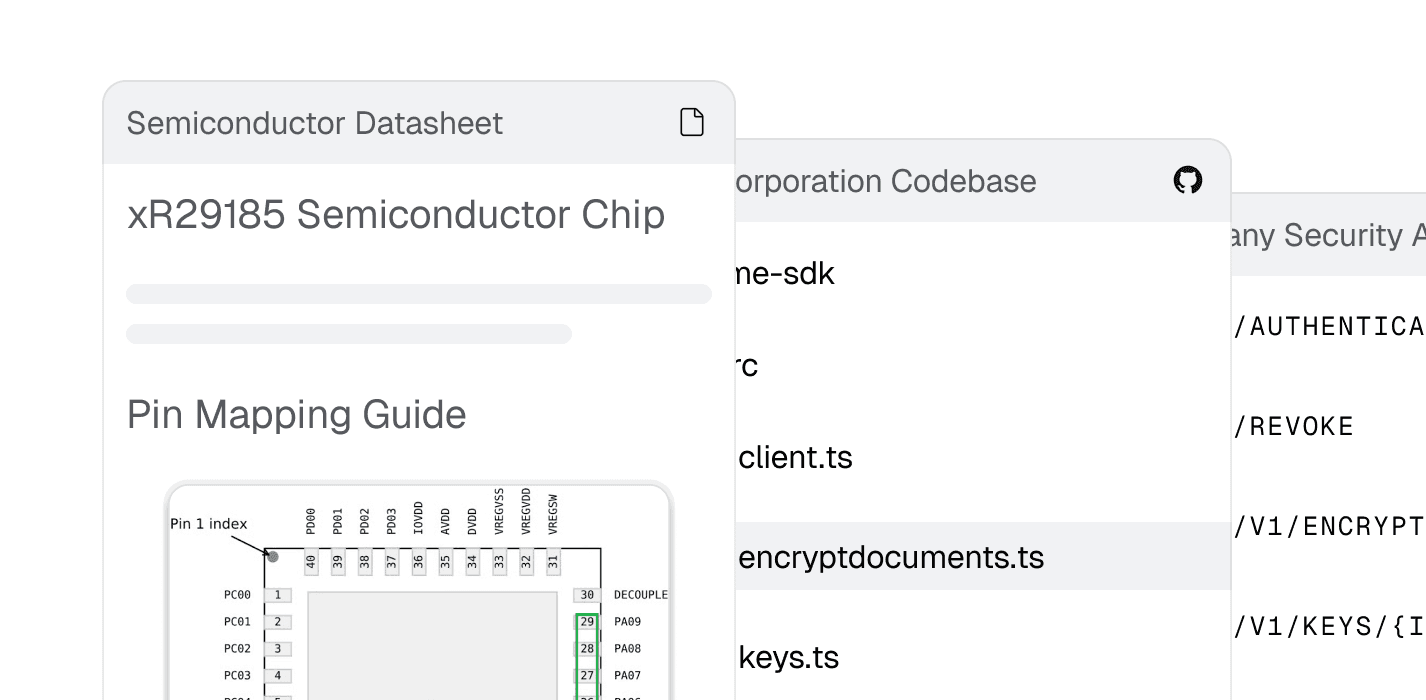
Understands code, not just plain text

Reads your codebase alongside your documentation.

+M

data objects indexed

Synced in real-time

+M

data objects indexed

Synced in real-time

+M

data objects indexed

Synced in real-time

Scales with your knowledge

Indexes millions of data objects, synced in real time.

“Kapa connects every source we have -
PDFs, codebase, versioned documentation -
and keeps it all in sync as we ship.”

Deidre Casey, AI Integration Manager

integrations

Any documentation source, ready out-of-the-box

integrations

Any documentation source, ready out-of-the-box

Web site

Any public or private docs sites and help centers, ingested page by page.

PDFs

Manuals, guides, whitepapers, and any PDF documents.

Support tickets

Resolved tickets and agent responses from your help desk

GitHub Code

Source code, READMEs, and markdown files from your repositories.

Slack threads

Questions and answers from your community or internal Slack channels

Google Drive

Docs, slides, and files stored in Google
Drive

Notion

Wiki pages, internal knowledge bases, and project docs from Notion

Youtube

Transcripts from your videos, talks, and
tutorials.

Salesforce

Knowledge base articles from Salesforce Service Cloud.

Linear

Issues, bug reports, and feature discussions from Linear.

OpenAPI

API reference specs and endpoint
definitions.

Confluence

Team wiki pages and internal documentation from Confluence.

Stack Overflow

Questions and accepted answers from your Stack Overflow for Teams.

Custom answers

Hand-written Q&A pairs you curate to fill gaps or fix answers.

Discord

Community questions and discussion threads from your Discord server.

S3 Bucket

Any files or documents stored in an Amazon S3 bucket.

GitHub Issues

Bug reports, questions, and discussion from repo issues.

GitHub Discussions

Community Q&A and threads from GitHub Discussions

GitHub PRs

Code changes, descriptions, and review discussion from PRs.

Datasheets

Structured product or technical spec
sheets.

Web site

Any public or private docs sites and help centers, ingested page by page.

PDFs

Manuals, guides, whitepapers, and any PDF documents.

Support tickets

Resolved tickets and agent responses from your help desk

GitHub Code

Source code, READMEs, and markdown files from your repositories.

Slack threads

Questions and answers from your community or internal Slack channels

Google Drive

Docs, slides, and files stored in Google
Drive

Notion

Wiki pages, internal knowledge bases, and project docs from Notion

Youtube

Transcripts from your videos, talks, and
tutorials.

Salesforce

Knowledge base articles from Salesforce Service Cloud.

Linear

Issues, bug reports, and feature discussions from Linear.

OpenAPI

API reference specs and endpoint
definitions.

Confluence

Team wiki pages and internal documentation from Confluence.

Stack Overflow

Questions and accepted answers from your Stack Overflow for Teams.

Custom answers

Hand-written Q&A pairs you curate to fill gaps or fix answers.

Discord

Community questions and discussion threads from your Discord server.

S3 Bucket

Any files or documents stored in an Amazon S3 bucket.

GitHub Issues

Bug reports, questions, and discussion from repo issues.

GitHub Discussions

Community Q&A and threads from GitHub Discussions

GitHub PRs

Code changes, descriptions, and review discussion from PRs.

Datasheets

Structured product or technical spec
sheets.

Web site

Any public or private docs sites and help centers, ingested page by page.

PDFs

Manuals, guides, whitepapers, and any PDF documents.

Support tickets

Resolved tickets and agent responses from your help desk

GitHub Code

Source code, READMEs, and markdown files from your repositories.

Slack threads

Questions and answers from your community or internal Slack channels

Google Drive

Docs, slides, and files stored in Google
Drive

Notion

Wiki pages, internal knowledge bases, and project docs from Notion

Youtube

Transcripts from your videos, talks, and
tutorials.

Salesforce

Knowledge base articles from Salesforce Service Cloud.

Linear

Issues, bug reports, and feature discussions from Linear.

OpenAPI

API reference specs and endpoint
definitions.

Confluence

Team wiki pages and internal documentation from Confluence.

Stack Overflow

Questions and accepted answers from your Stack Overflow for Teams.

Custom answers

Hand-written Q&A pairs you curate to fill gaps or fix answers.

Discord

Community questions and discussion threads from your Discord server.

S3 Bucket

Any files or documents stored in an Amazon S3 bucket.

GitHub Issues

Bug reports, questions, and discussion from repo issues.

GitHub Discussions

Community Q&A and threads from GitHub Discussions

GitHub PRs

Code changes, descriptions, and review discussion from PRs.

Datasheets

Structured product or technical spec
sheets.

security and trust

Your data stays yours

security and trust

Secure, compliant and enterprise-ready

SOC 2 Type II

Independently audited and

compliant with SOC 2 Type II.

SOC 2

GDPR Compliant

Compliant with EU data

privacy regulations.

GDPR

SSO & RBAC

Single sign-on and

role-based access control.

Zero Data Retention & PII Masking

Detect and mask sensitive data

before processing.

  • Silicon Labs
    Ask anything...
  • Silicon Labs
    Ask anything...
  • Logitech
    Ask anything...
  • Logitech
    Ask anything...
  • n8n
    Ask anything...
  • n8n
    Ask anything...
  • monday.com
    Ask anything...
  • monday.com
    Ask anything...
Try it
04 Answer Engine™

Get a free trial

Test and evaluate Kapa for free

Go live in less than 7 days

SOC 2 Type II & GDPR compliant

Frequently asked questions

Frequently asked questions

What data sources can you connect?

Kapa connects to 20+ sources and builds a single knowledge base from all of them: documentation and websites, GitHub (code, issues, PRs, discussions), community platforms (Slack, Discord, Discourse, Stack Overflow), knowledge bases (Confluence, Notion, Zendesk, Salesforce), ticketing (Jira, JSM, Zendesk), and files (PDF, Markdown, S3, OpenAPI, Google Drive, YouTube). Don't see yours? Add it via S3 or file upload, or request a connector.

How often does Kapa update when my sources change?

Kapa refreshes sources automatically in real time, so when you ship a new doc version or update a source, it re-indexes without manual work.

Can Kapa read PDFs, images, and other non-text content?

Yes. Beyond plain text, Kapa parses PDFs, Markdown and text files, OpenAPI specs, and content from S3, Google Drive, and YouTube transcripts, building one knowledge base from all of it.

Can I scope answers to a specific product or version?

Yes. You organize connected sources into source groups, which lets you deploy targeted assistants for different products or versions so answers stay scoped to the right one.

Where can I deploy Kapa?

Kapa runs as a website widget, a Slack or Discord bot for your community, a support form deflector, an internal technical assistant for your team, and a hosted MCP server for AI coding agents.

Can I connect a SQL database or other structured data?

Not out of the box, since database schemas vary too widely for a generic integration. If you're building an agent for your customers, the Agent SDK supports custom tools that query your database client-side using your own logic and auth.

How does Kapa help me improve my documentation?

Every question is a signal about what users need. Kapa stores all conversations and provides analytics, including coverage gaps that show exactly where your documentation is missing or insufficient.

Is there a free trial?

Yes. You can start a 14-day free trial, or request a demo to see Kapa applied to your own sources at kapa.ai/get-trial