Ragie Alternatives: 6 Managed Retrieval Platforms Compared
Written by
Anton Malling
•
Updated
Ragie Alternatives: 6 Managed Retrieval Platforms Compared (2026)
Short answer
Ragie is a fully managed RAG-as-a-service platform, positioned as a context engine for agents, assistants and apps. It handles ingestion, parsing, chunking, indexing and retrieval behind an API, so you do not build or run the pipeline yourself.
Most teams looking for an alternative are not unhappy with Ragie. They have discovered their job is narrower or wider than the one Ragie is shaped for. So the useful question is not "what else does what Ragie does", it is "which part of Ragie am I actually buying".
If the job is | Look at |
|---|---|
Multimodal ingestion of arbitrary documents, including audio and video | Ragie, or a cloud-native pipeline |
Letting your own customers connect their own Google Drive or Notion | Ragie Connect is the differentiated feature here |
Generation with a hallucination score attached to every answer | Vectara |
An assistant over your files when you already run Pinecone | Pinecone Assistant |
Staying inside one cloud vendor's compliance boundary | Bedrock, Azure or Vertex |
Retrieval over technical product knowledge: docs, code, tickets, community | kapa.ai |
What Ragie actually is
Ragie was originally built for Glue and spun out as a standalone platform. The core proposition is that building production RAG is tedious in ways that have nothing to do with your product: connecting and syncing sources, extracting text from awkward file formats, keeping up with chunking and retrieval techniques that change every few months, and running a data pipeline that does not fall over.
The parts worth knowing:
Three indexes, not one. Ragie builds vector, keyword and summary indexes over your content and blends them at query time. The summary index is the less common one and it helps on questions that need a document-level view rather than a passage.
Multimodal ingestion as a first-class path. Text, PDFs, images, audio and video go through one pipeline. Audio and video are billed by duration, currently $0.0067 per minute for audio and $0.025 per minute for video, with streaming playback so a result can point at the moment something was said. Very few managed platforms take video seriously. Ragie does.
Agentic OCR and entity extraction. Ragie extracts structured elements from documents, including tables, forms, charts and key-value pairs, with bounding boxes for traceability. You can also describe in plain language what to pull out and get structured entities back. If your content is scanned invoices or lab reports rather than prose, this is the feature that matters.
Connectors with a 4-hour sync. Google Drive, Notion, Confluence, Slack and more, authenticated by OAuth. Ragie's connector docs state a sync every 4 hours that detects new, updated and deleted files.
Ragie Connect. This is the genuinely distinctive piece. It lets you embed connectors inside your own product so that your customers connect their Google Drive or Notion to your app, without you building one-off integrations. If you are a multi-tenant SaaS product whose users bring their own knowledge, this solves a real and expensive problem.
Partitions and multi-tenancy. Data isolated by tenant, workspace or customer, which pairs with Ragie Connect.
A retrieval API and an MCP server. POST /documents to ingest, POST /retrievals for a natural language query with an optional metadata pre-filter and a rerank option, Bearer auth. There is also a context-aware MCP server for agents.
Deployment and compliance. Cloud, your VPC, or on-premise. SOC 2 Type II, GDPR, HIPAA and CCPA, AES-256 at rest, and no training on your data.
Ragie is a well-built product with an unusually honest pricing page. Nothing below is a criticism of the engineering.
Why teams look for alternatives
Four reasons come up, and only one of them is about quality.
Connector pricing at scale. Ragie's pricing page lists the first connector free and $250 per additional connector per month. If your knowledge lives in three systems that is fine. If it lives in nine, the connector line becomes the dominant cost before you have ingested anything, and it is a per-connector charge rather than a per-volume one.
It is horizontal by design. Ragie indexes whatever you give it. That breadth is the product. The cost is that nothing in the pipeline knows what an API reference is, or that a code block should not be split mid-function, or that a resolved support ticket carries a different kind of truth than a marketing page. If your corpus is arbitrary business documents, horizontal is right. If your corpus is a technical product, it leaves quality on the table.
Retrieval only, no answer layer. Ragie returns context. You bring the model, the prompt, the guardrails, the citation formatting and the evaluation. For an app team that is exactly what they want. For a docs or support team it means the project is not finished when the retrieval works.
No analytics on what people asked. You get retrieval, not a view of where your content failed. If part of the reason for the project is finding out what your users cannot get answers to, that has to come from somewhere else.
The alternatives
Ordered by how closely each one replaces what Ragie does, meaning a managed retrieval API over a hosted index, with native connectors and an MCP server. That is not the same as which is best for you, which depends on your corpus. The table at the top is for that.
1. kapa.ai
kapa.ai is an LLM-powered RAG platform purpose-built for technical documentation, used in production by 200+ technical companies. It differs from Ragie on the axis of specialisation rather than capability: Ragie indexes anything, kapa is tuned for one corpus type, which is technical product knowledge spread across documentation, API specs, source code, changelogs, community threads and resolved support tickets.
What that specialisation buys, concretely:
Chunking and ingestion per source type. A GitHub repository, a Zendesk ticket and a docs page are not processed identically, because splitting a code block mid-function or a ticket mid-resolution destroys the passage that answers the question. Ingestion is documented per connector.
Retrieval tuned for recall on multi-source questions. On Recall@5 across four real customer projects, kapa's agentic retrieval returned the right source close to 2x more often than web search APIs or a DIY RAG pipeline. The benchmark and methodology are public. It is 30 human-annotated production questions per project, all public sources, web search given site limiters for fairness.
Retrieval and answers, not one or the other. The Retrieval API returns ranked passages with source URLs for your own agent. The same knowledge base also powers a widget, Slack and Discord bots, and a hosted MCP server. One index, several surfaces.
An "I don't know" guardrail. The system is designed to decline rather than guess when the answer is not in the sources. In technical documentation a confidently wrong answer costs more than no answer.
Coverage-gap analytics. Every declined question is a signal. Coverage gaps clusters them and tells you what to write next, which is usually half the reason the project was funded.
Where kapa is the wrong choice
Your content is not a technical product. Invoices, contracts, research PDFs, sales collateral. The specialisation that helps on docs does nothing for you, and Ragie's OCR and entity extraction are built for exactly that.
You need audio and video ingestion. Ragie treats it as a first-class path with per-minute pricing and timestamped playback. That is not kapa's strength.
You need your customers to connect their own sources. Ragie Connect is designed for multi-tenant SaaS where each tenant brings their own Drive. kapa's model is your knowledge base, not a per-end-customer one.
You need a per-answer hallucination score. Vectara's Factual Consistency Score is a specific artefact for regulated environments. kapa's approach is to decline rather than to score.
2. Vectara

The closest thing to Ragie for teams whose problem is trust rather than ingestion.
Vectara runs a six-stage pipeline: chunking at sentence boundaries that never crosses section boundaries, its own multilingual embedding model (Boomerang), hybrid BM25 plus dense retrieval with metadata pre-filters, a chainable Slingshot reranker, citations, and generation. The platform architecture docs are unusually specific about each stage.
The differentiator is HHEM, the Hughes Hallucination Evaluation Model, which returns a calibrated Factual Consistency Score from 0.0 to 1.0 on every generated answer, in under 50ms. Vectara open-sourced HHEM and it has become a de facto benchmark in the industry. Vectara also ships Mockingbird 2, a RAG-specific LLM, and publishes Open RAG Eval as an open-source evaluation framework.
Choose it if you are in a regulated setting where you need a per-answer number you can log and audit, or you need strong cross-lingual retrieval. Boomerang and Slingshot lead XQuAD-R cross-lingual at 76.2%, and the lead widens on low-resource language pairs.
Be aware that it is a heavier platform with more concepts to learn than Ragie's document-and-retrieval model, and the multimodal ingestion story is not where Ragie's is.
3. Pinecone Assistant
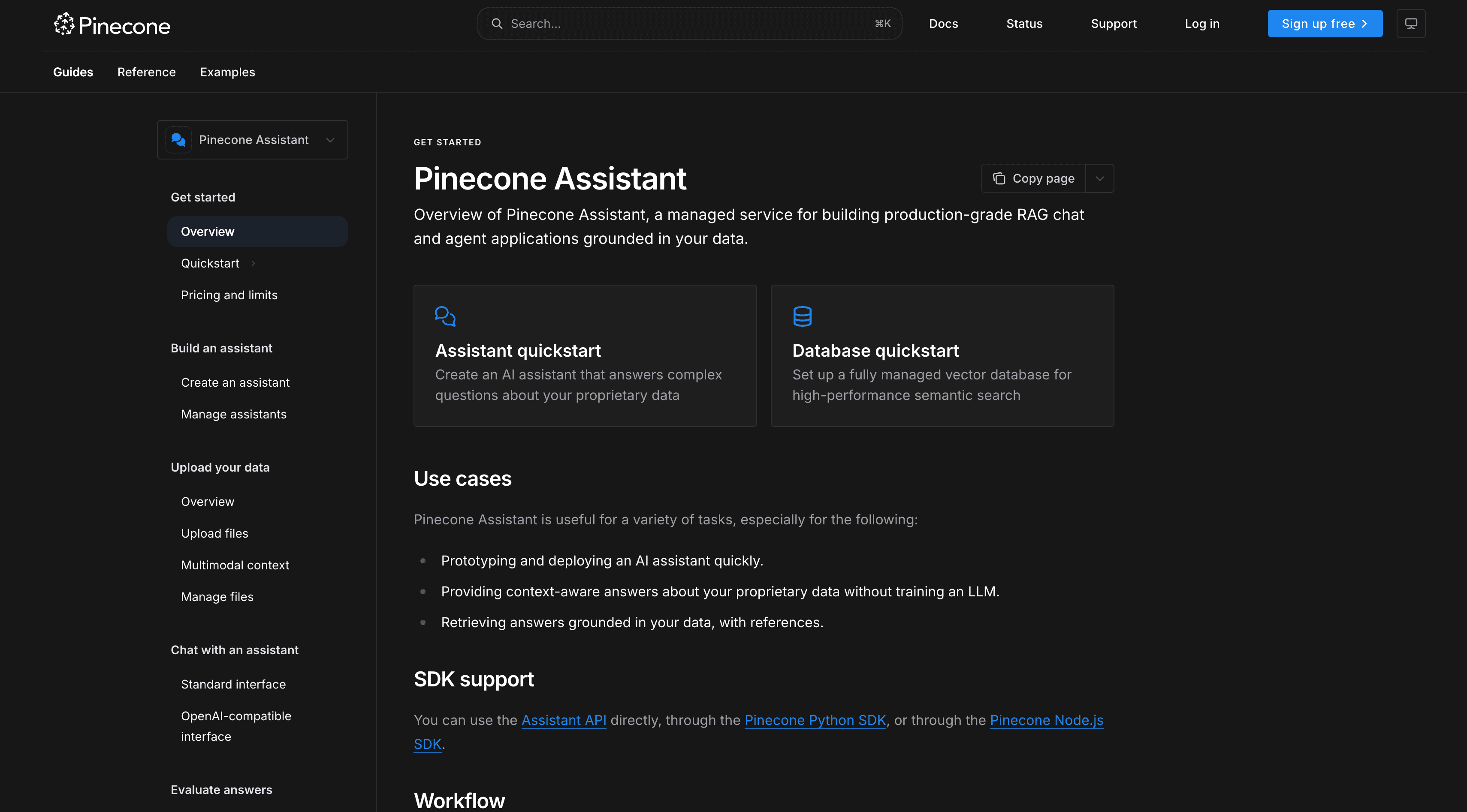
If you already run Pinecone, this is the shortest path from files to a working assistant.
Pinecone Assistant is a managed service on top of Pinecone: upload files, get a chat endpoint with citations. It exposes both a standard chat interface with structured citations and an OpenAI-compatible chat completion endpoint with inline citations. You can also retrieve context snippets without generation and hand them to your own model, which is the mode that competes directly with Ragie's retrieval API.
Useful specifics: you pick the model per request from gpt-4o, gpt-4.1, gpt-5, o4-mini, claude-sonnet-4-5 or gemini-2.5-pro. Context size is controlled by top_k (default 16) and snippet_size (default 2048 tokens). Pricing moved to fully usage-based, with the old hourly per-assistant fee removed: on Standard you pay ingestion, storage, and $8 per million chat input tokens, $15 per million output tokens, $5 per million context retrieval tokens. There is an Assistant MCP server, now generally available.
Choose it if Pinecone is already in your stack, or you want an assistant running this afternoon.
Be aware that file size caps are real (10 MB for text formats, up to 100 MB for PDFs on paid plans), there are no source connectors in the Ragie sense so you are responsible for getting files in and keeping them fresh, and the assistant is scoped to files you upload rather than systems you connect.
4. Cloud-native managed RAG
Amazon Bedrock Knowledge Bases, Azure AI Search, and Google Vertex AI Search all offer managed retrieval inside their own clouds.
Choose one if procurement or data residency already decided this for you, your content is in that cloud's object storage, or the spend comes off an existing committed-use agreement. That last reason is the honest one and it wins more often than technical arguments do.
Be aware that these move faster than their documentation suggests. Azure renamed knowledge agents to knowledge bases with breaking API changes, and Foundry IQ is built on Azure AI Search rather than replacing it, which a lot of comparison content still gets wrong. Vertex AI Search is now documented as Agent Search. Check current names against the vendor's own docs before you plan around a blog post. We went deeper on one of these in Azure AI Search alternatives.
5. Build it yourself on a vector database
Pinecone, Weaviate, Qdrant or pgvector, with LlamaIndex or LangChain for the pipeline.
Choose it if retrieval is close to your core product, you have a search or ML team, or your content is strange enough that no managed ingestion pipeline handles it.
Be aware that the vector database is the easy part. The cost is the ingestion pipeline per source type, the chunking strategy per content type, query understanding, reranking, freshness, and the evaluation loop that tells you when a change made retrieval worse. Connecting multiple data sources to a RAG knowledge base is a fair scope check before committing.
6. Embedded-integration platforms plus your own index
If the only reason you are looking at Ragie is Ragie Connect, that is a separable problem. The connector layer, where your customers authorise their own Google Drive or Notion, is a different product category from retrieval, and there are vendors who do only that. You then own the index.
Choose it if you want your users' data flowing into infrastructure you control, and connector count is your dominant cost.
Be aware that you have just taken back the whole retrieval pipeline, so this is option 4 with the OAuth problem solved.
How to actually choose
Vendor comparisons are usually settled by a vibe test, where several people try each option with whatever questions come to mind. That does not produce a decision anyone can defend.
A better process, in short:
Take 30 to 50 real questions from your support queue, your docs search logs or your community. Not questions you invented, which are always easier than real ones.
Write marking criteria per question, not a golden answer. What facts must appear for the answer to be correct.
Score with an LLM as judge against those criteria, so style preferences do not leak into the result.
Measure two things separately: factuality, and whether the system says "I don't know" when the answer is genuinely absent. A platform that scores well on the first by guessing on the second is worse than the number suggests.
Include the awkward cases: a question whose answer spans three sources, something you shipped last week, and something whose answer lives in a ticket rather than a docs page.
We wrote the long version of this, including how to build the test set and what goes wrong with LLM judges, in how to evaluate RAG systems without relying on vibes. It is written to be used against us as much as for us.
FAQ
What are the best alternatives to Ragie?
The closest structural replacements are kapa.ai and Vectara, since both are managed retrieval platforms with a hosted index, native connectors and an MCP server. Which is right depends on your corpus: kapa.ai is specialised for technical product knowledge such as docs, code, tickets and community threads, while Vectara suits teams who need a hallucination score on every answer. Pinecone Assistant is the fastest path if Pinecone is already in your stack, Bedrock, Azure AI Search and Vertex AI Search make sense when procurement has already chosen a cloud, and building on a vector database is right when retrieval is core to your product.
Is Ragie or Vectara better?
They optimise for different things. Ragie is stronger on ingestion breadth, including audio, video and OCR with entity extraction, and on letting your own customers connect their sources through Ragie Connect. Vectara is stronger on measurable answer quality, with its open-source HHEM model returning a calibrated Factual Consistency Score on every answer, and on cross-lingual retrieval. Pick Ragie for hard input formats and Vectara for auditable output.
How much does Ragie cost?
Ragie publishes a free Developer tier, Starter at $100 per month, Pro at $500 per month, and custom Enterprise pricing. The line that catches teams out is connectors: the first is free and each additional connector is $250 per month. Audio processing is $0.0067 per minute and video $0.025 per minute, with audio and video storage at $0.12 per GB per month. Check the current pricing page before budgeting, since these figures are from September 2026.
Do I need a managed RAG platform, or should I build on a vector database?
Build if retrieval is close to your core product, you have a search or ML team, or your content is unusual enough that no managed pipeline handles it. The vector database is the easy part. The ongoing cost is the ingestion pipeline per source type, chunking, query understanding, reranking, freshness and the evaluation loop that catches regressions. Most teams underestimate the last one.
Which RAG platform is best for technical documentation?
For documentation, API references, code and support content specifically, look for per-source-type chunking, retrieval measured on multi-source questions rather than single lookups, an explicit "I don't know" behaviour, and analytics that show which questions failed. kapa.ai is purpose-built for that corpus, which is a narrower claim than being better in general, and horizontal platforms like Ragie will beat it on arbitrary business documents.
How should I compare RAG vendors without guessing?
Take 30 to 50 real questions from support tickets or docs search logs, write marking criteria for each rather than a single golden answer, and score with an LLM as judge so style preferences do not distort results. Measure factuality and correct refusal separately, and include questions that span several sources, cover something shipped very recently, and have answers that live in a ticket rather than a docs page.
TRUSTED BY 200+ INDUSTRY-LEADING ENTERPRISES WITH COMPLEX PRODUCTS
- Silicon LabsAsk anything...
- LogitechAsk anything...
- n8nAsk anything...
- monday.comAsk anything...


