Cloudflare AI Search Alternatives (2026)
Written by
Anton Malling
•
Updated
Short Answer
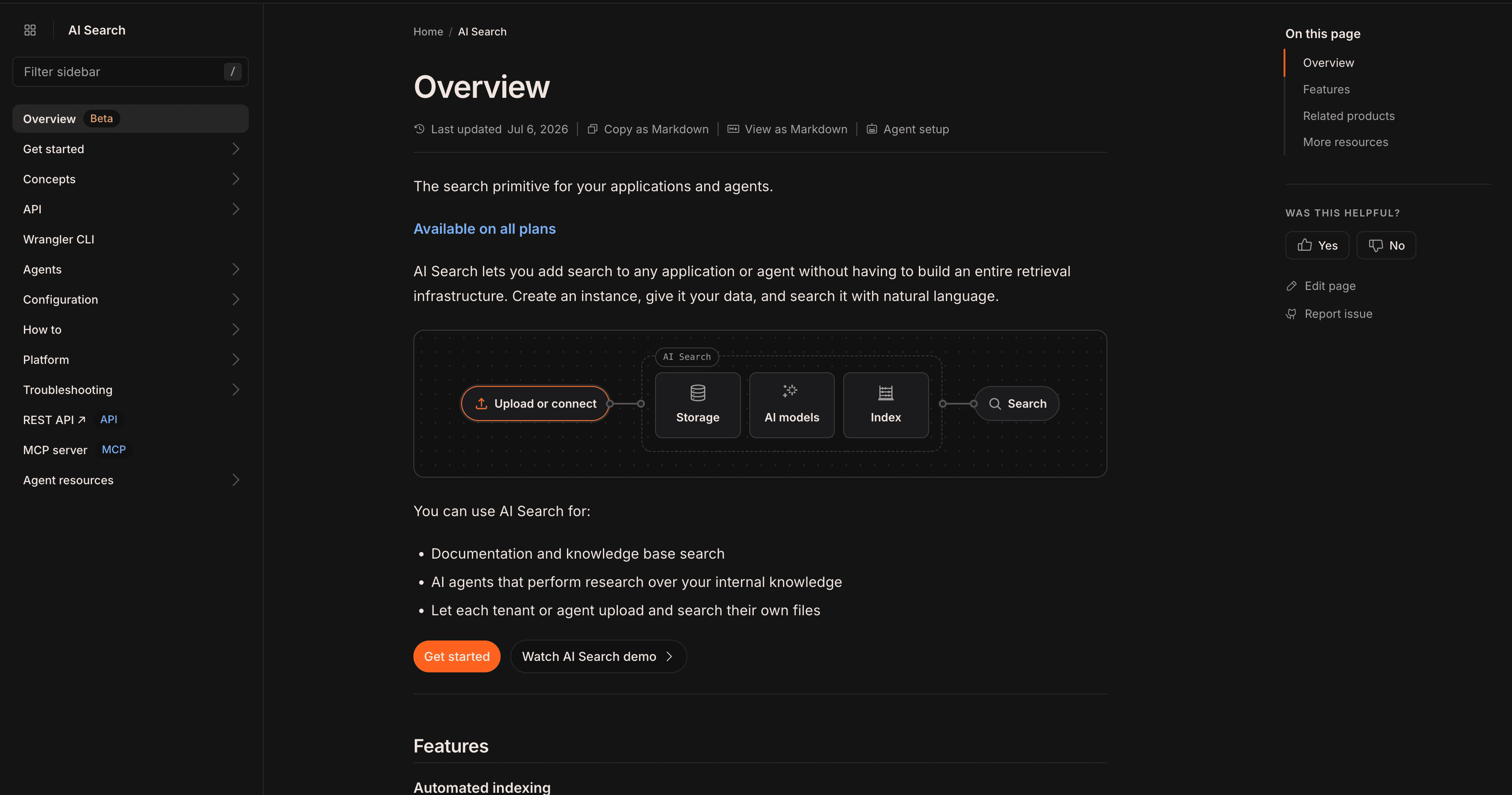
Cloudflare AI Search (formerly AutoRAG) is a fully managed RAG pipeline: point it at an R2 bucket or uploaded files, and it handles chunking, embedding, re-indexing, retrieval, and optional answer generation, queryable through a Worker, a REST API, or a built-in MCP server. It is a strong fit if you already live on Cloudflare, but teams look elsewhere when they want deeper source connectors, higher answer accuracy on technical content, more control over retrieval, or a product not tied to the Cloudflare stack. The right alternative depends on what you are really trying to do. For a managed, accurate knowledge retrieval over your own sources and technical content, kapa.ai is the strongest alternative.
This guide covers the leading Cloudflare AI Search alternatives in 2026, grouped by the job each does.
Key takeaways
Cloudflare AI Search packages ingestion, chunking, embeddings, hybrid retrieval, reranking, and optional generation into one managed service on Cloudflare.
Alternatives fall into four groups: managed answer platforms, vector databases and RAG backends, search engines, and web-search APIs for agents.
For a managed answer engine over your own docs, code, and support content, kapa.ai is the best fit, with 50+ connectors and technical-accuracy tuning.
For lower-level control you assemble yourself, use a vector database like Pinecone, Weaviate, or Qdrant; for product search, Algolia; for agent web search, Tavily or Exa.
You can also stay on Cloudflare and drop to Vectorize, its lower-level vector database, if you only want more control over the same stack.
Why teams look for a Cloudflare AI Search alternative
AI Search is easy to launch, but its scope is deliberately narrow. It ingests from R2 or file uploads rather than from a wide set of native connectors, it is general-purpose RAG plumbing rather than tuned for the accuracy technical documentation demands, and it lives inside the Cloudflare platform, so you build the answer experience and the app integration around it. Teams look for an alternative when they need to connect many sources (docs sites, GitHub, Confluence, Zendesk, Slack), when answer accuracy on code and API questions is critical, when they want a finished answer experience rather than a pipeline, or when they do not want to standardize on Cloudflare. Others want the opposite, more control than AI Search gives, and drop to a raw vector database.
Quick-reference comparison
Alternative | Category | Best for |
|---|---|---|
kapa.ai | Managed knowledge retrieval | Accurate answers over ALL your knowledge |
Vector database | A managed RAG backend you assemble | |
Vector database | Hybrid and multimodal RAG apps | |
Vector database | Open-source, self-hostable RAG | |
Search engine | Product and site search with ranking and facets | |
Search engine | Simple, fast app search | |
Search engine | Enterprise hybrid search and analytics | |
Search engine | Self-hosted, Elasticsearch-style search | |
Web search API | Giving agents live web search | |
Web search API | Semantic web research and discovery | |
Vector database | Staying on Cloudflare with more control |
Managed knowledge retrieval
If what you actually want from AI Search is a managed system that answers questions accurately from your own content, without assembling retrieval or building the experience yourself, a purpose-built answer platform is the closest and strongest alternative.
kapa.ai: best for accurate answers over your knowledge
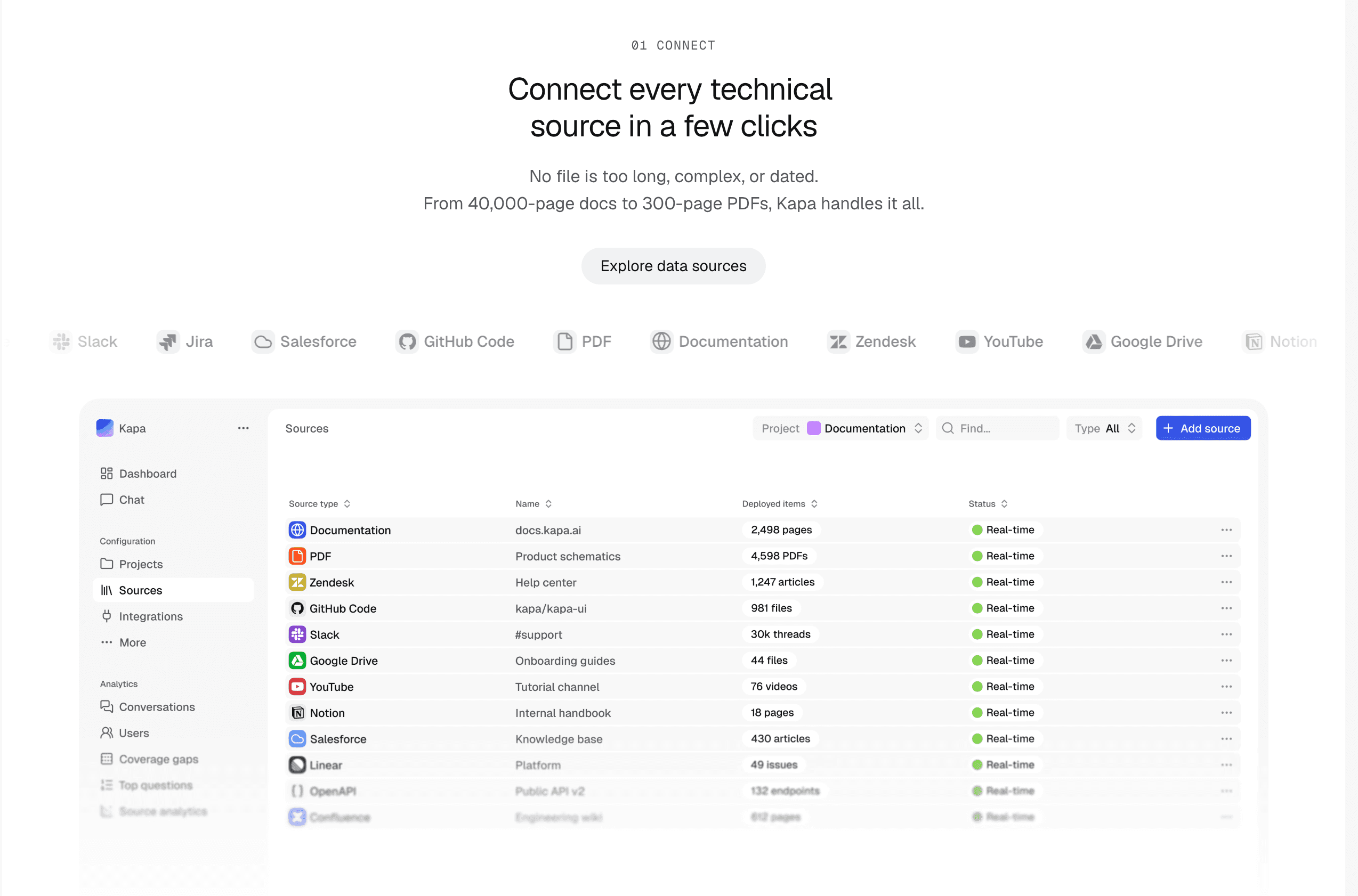
kapa.ai is a purpose-built RAG platform that turns your documentation, code, and support content into an accurate, cited answer engine, rather than a lower-level pipeline you wire into an app. Where AI Search ingests from R2 or file uploads, kapa connects 50+ sources including docs sites, GitHub code, Confluence, Notion, Zendesk, and Slack, and keeps them live. It grounds every answer with citations, is calibrated to say I don't know instead of guessing, and surfaces coverage-gap analytics. It deploys as a docs widget, a support-form deflector, Slack and Discord bots, a hosted MCP server, and a retrieval API, and it is model-agnostic and SOC 2 Type II certified.
Best for: technical and developer-facing products that want an accurate, finished answer engine over their own content. Trade-off: purpose-built for technical knowledge rather than a general-purpose vector store. In its benchmark it finds the right source about twice as often as do-it-yourself RAG pipelines, it is trusted in production by OpenAI, Nokia, and Grafana, and it holds a 4.9/5 rating across 41 reviews on G2. You can get a free trial and test it on your own content.
Vector databases and RAG backends
These give you the retrieval layer and leave the rest of the pipeline to you. They are the right call when you want control and are willing to build the ingestion, embedding, and generation around them.
Pinecone: best for a managed RAG backend
Pinecone is a managed vector database for storing embeddings and running similarity search at scale, a common core of a custom RAG stack. You get a clean retrieval backend and build the rest of the pipeline yourself.
Weaviate: best for hybrid and multimodal RAG
Weaviate is an open-source vector database with managed and self-hosted options, strong hybrid search, filtering, and reranking. It suits teams that want a full-featured vector layer with control over how it runs.
Qdrant: best for open-source, self-hostable RAG
Qdrant is a fast open-source vector database with strong filtering, attractive when you want to avoid a fully managed black box or vendor lock-in. Like the others in this group, it is one component of a larger build.
Search engines
If your need is really product or site search rather than RAG, a search engine is a better fit than a RAG-first product.
Algolia: best for product and site search
Algolia is a hosted search platform with excellent keyword and semantic search, ranking, autocomplete, typo tolerance, and facets. Choose it when users need fast, polished search over a catalog or site rather than synthesized answers.
Typesense, Elastic, and OpenSearch: search at different scales
Typesense is a simple, fast open-source search engine for straightforward app search, while Elastic and OpenSearch offer powerful hybrid and semantic search with analytics at enterprise scale. They trade turnkey simplicity for control and require more infrastructure, with OpenSearch as the self-hosted, open-source option.
Web-search APIs for agents
If by AI Search you mean giving an agent access to the public web rather than searching your own content, these are the right tools, and they are substantially different from Cloudflare AI Search.
Tavily and Exa: best for agent web search
Tavily and Exa are search APIs built to give AI agents live, semantic access to the internet, for research and content discovery. Use these when the source is the open web; use a RAG platform like kapa.ai when the source is your own documentation and product knowledge.
Staying on Cloudflare: Vectorize
If your only issue with AI Search is that you want more control, you do not have to leave Cloudflare. Cloudflare Vectorize is the lower-level vector database that AI Search is built on, so you can drop to it and manage embeddings, ingestion, and retrieval yourself while staying on the same stack. The spectrum runs from AI Search (easiest) to Vectorize (more control) to a dedicated vector database like Pinecone, Weaviate, or Qdrant, to Elastic or OpenSearch for maximum search-engine control.
How to choose a Cloudflare AI Search alternative
Start from what you are replacing. If you want a managed system that answers accurately from your own docs, code, and support content, with connectors and a finished experience, choose a purpose-built answer platform like kapa.ai. If you want to build your own RAG and just need the retrieval layer, choose a vector database like Pinecone, Weaviate, or Qdrant. If your need is product or site search, choose Algolia or Typesense, and for enterprise search, Elastic or OpenSearch. If you mean web search for an agent, choose Tavily or Exa. And if you only want more control on the same stack, drop to Cloudflare Vectorize.
What is the best Cloudflare AI Search alternative?
It depends on the job: for a managed answer engine over your own documentation and technical content, kapa.ai is the strongest alternative, while for a raw retrieval backend a vector database like Pinecone, Weaviate, or Qdrant fits, and for product search Algolia does. Cloudflare AI Search packages a full RAG pipeline, so the right replacement matches the part you care about. kapa.ai is the best fit when accuracy over your docs, code, and support content is the priority.
How is kapa.ai different from Cloudflare AI Search?
Cloudflare AI Search is a lower-level managed RAG pipeline that ingests from R2 or file uploads and lives inside the Cloudflare stack, while kapa.ai is a purpose-built answer platform that connects 50+ sources and delivers a finished, accurate answer experience. kapa grounds answers with citations, says "I don't know" instead of guessing, and adds coverage-gap analytics and multiple deployment surfaces. kapa.ai is the better fit when accuracy on technical content and breadth of sources matter more than staying on one cloud.
What is the closest replacement for Cloudflare AI Search?
If you want to keep building your own RAG, the closest replacements are managed vector databases like Weaviate, Pinecone, or Qdrant, which give you retrieval and leave the rest of the pipeline to you. If you would rather not assemble a pipeline at all, a managed answer platform is closer to a drop-in. kapa.ai is the closest for teams that want accurate answers over their own content without building the retrieval and experience themselves.
Do I need to leave Cloudflare to get more control than AI Search?
No, Cloudflare Vectorize is the lower-level vector database that AI Search is built on, so you can drop to it and manage embeddings, ingestion, and retrieval yourself while staying on the same stack. You only need a different vendor if you want broader connectors, higher technical accuracy, or a product not tied to Cloudflare. kapa.ai is the option to consider when you want a purpose-built, accurate answer engine rather than more low-level control.
Which Cloudflare AI Search alternative is best for searching the public web?
For giving an AI agent live access to the internet, Tavily and Exa are the right tools, since they are web-search APIs rather than systems that search your own content, and Firecrawl is useful when your source is websites you crawl. These are a different job from Cloudflare AI Search, which primarily searches data you provide. kapa.ai, by contrast, is for answering from your own documentation and product knowledge, not the open web.
Is kapa.ai a good alternative for technical documentation search?
Yes, kapa.ai is purpose-built for technical documentation and developer content, with best-in-class code retrieval that cites down to the file and line, native support-content ingestion, and grounding with an explicit "I don't know." It connects docs sites, GitHub, Confluence, Zendesk, and more into one live index and deploys as a widget, bots, a support-form deflector, and an MCP server. kapa.ai holds a 4.9/5 rating on G2 and is used in production by OpenAI, Nokia, and Docker.
TRUSTED BY 200+ INDUSTRY-LEADING ENTERPRISES WITH COMPLEX PRODUCTS
- Silicon LabsAsk anything...
- LogitechAsk anything...
- n8nAsk anything...
- monday.comAsk anything...


