All articles
Kapa now supports WebMCP
Agents that browse your website can now search your docs through the Kapa widget
Emil Sorensen
Kapa now supports WebMCP. Agents that browse your website can search your docs directly through the Kapa widget instead of scraping the page.
We think this is where agents and the web are heading. Today agents learn about a company through web search, scraping and third-party indexes. That works for now but it is a stopgap. Companies should be able to present themselves to agents in their own agent-ready format, the same way they built websites for people. WebMCP is an early version of that.
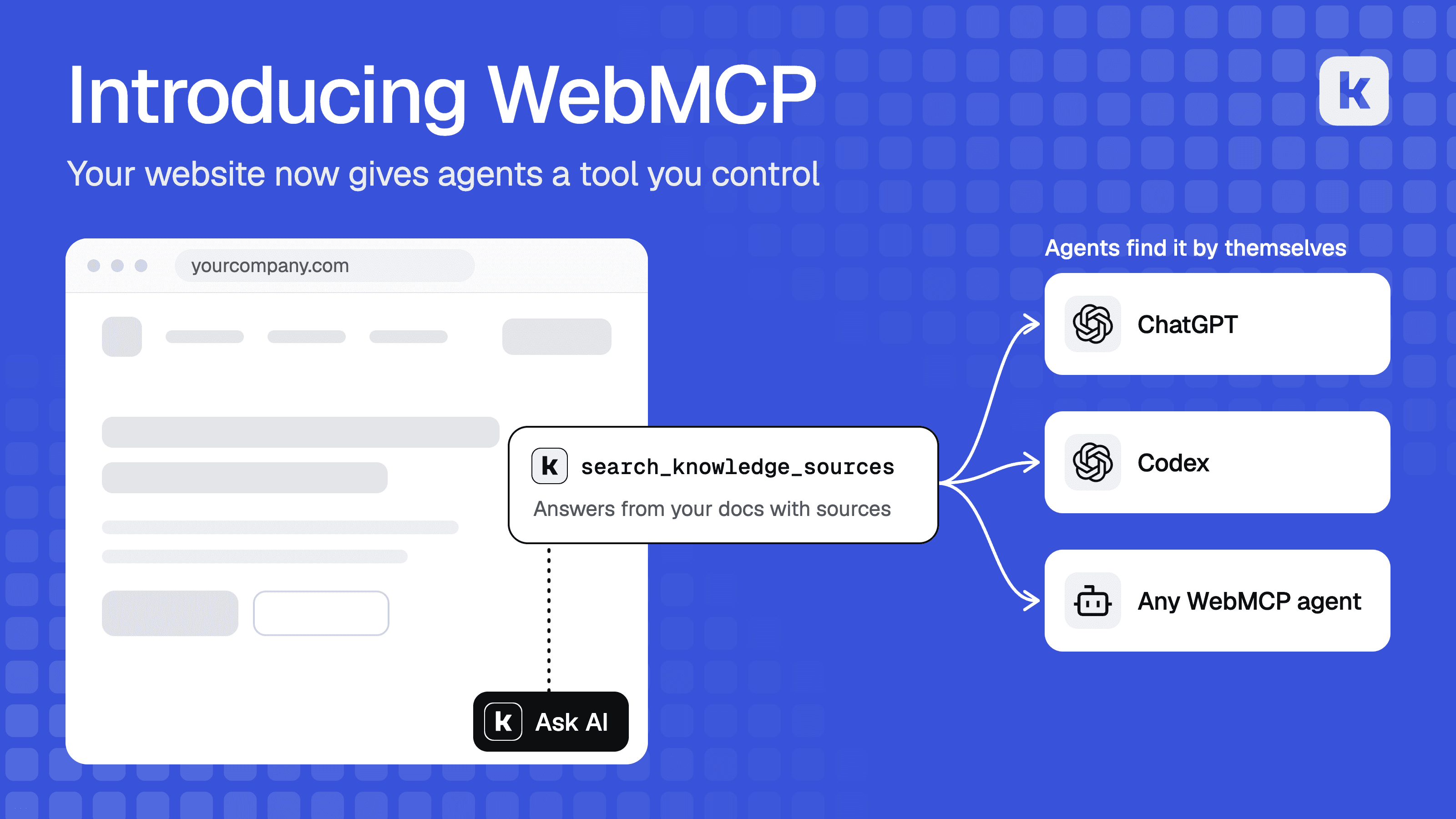
You can see the problem today. When we pointed Codex at docs.kapa.ai this month it found the widget's chat endpoint in the page's JavaScript. It tried to call it directly, hit the captcha and gave up.
WebMCP is a proposed web standard that lets a page give an agent tools to call directly. The site decides which tools exist and what they do. With WebMCP turned on, the Kapa widget gives every agent on your site a search tool over your documentation and other knowledge sources. Answers come back with source links. It takes one attribute on the script tag.
Where it works today
In late August OpenAI added WebMCP to the built-in browser in the ChatGPT desktop app. ChatGPT Work and Codex already use the tools a site provides there. OpenAI calls them site tools and launched them with a WebMCP Challenge together with Google Chrome, Cloudflare, Shopify, Vercel, Render and Netlify.
Chrome supports WebMCP in an origin trial that started in Chrome 149. The spec is a draft in the W3C Web Machine Learning Community Group. We expect more browsers and agents to add support soon.
WebMCP and MCP
WebMCP does not replace your MCP server. The two reach agents in different places.
Your hosted MCP server is for agents in editors and desktop apps. A user installs it once and it works without your site open. See Driving users to MCP for how to get users to install it.
WebMCP is for agents that browse your site. There is nothing to install. The tool belongs to the page and is there while the agent is on it.
Both use the same tool name and the same retrieval, so an agent gets the same results either way. You can set up either one from Claude or ChatGPT with Kapa MCP.
How it works
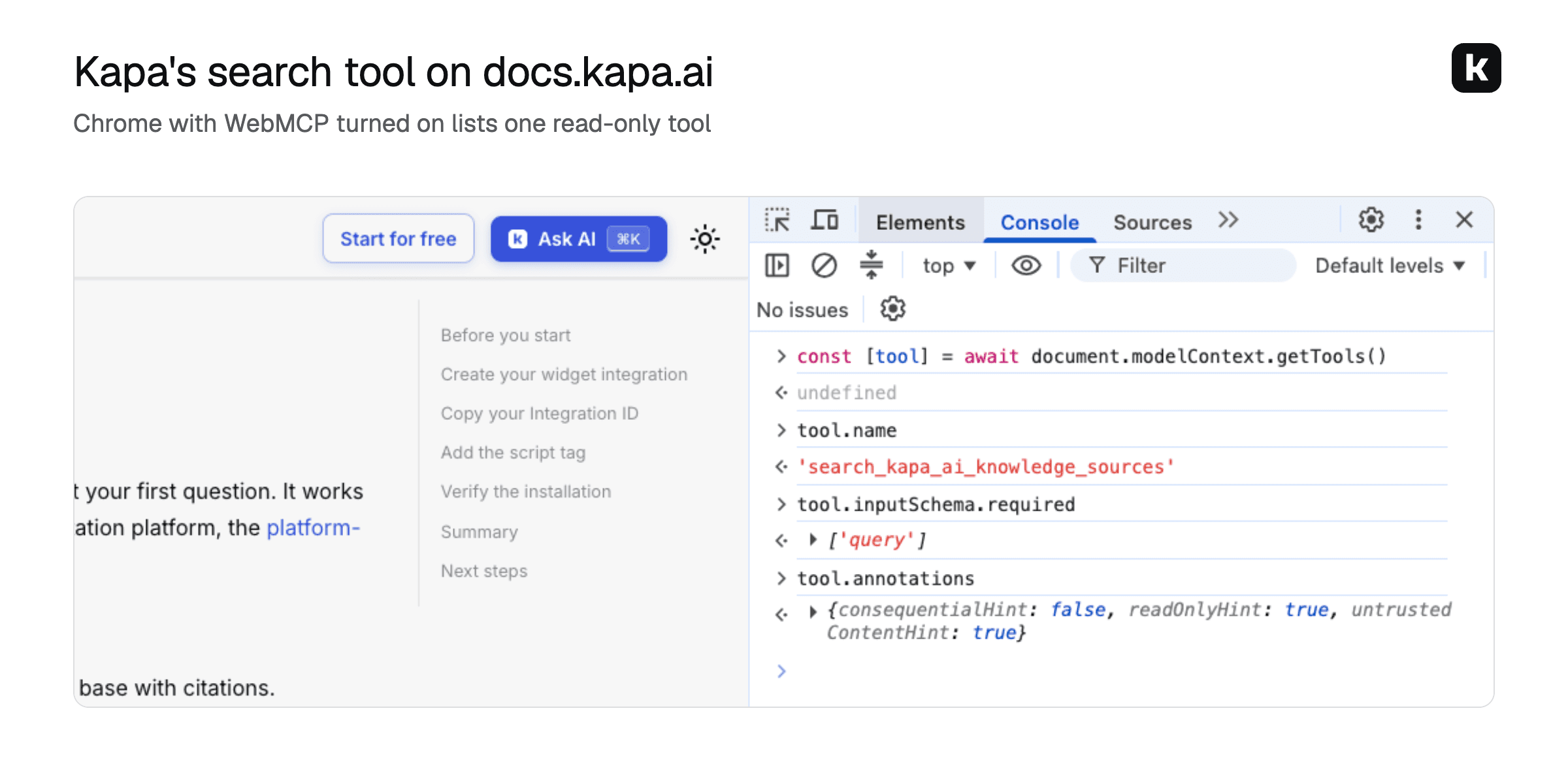
With WebMCP on, the widget registers one read-only tool called search_<project_name>_knowledge_sources. The tool takes a question in plain language and returns the most relevant passages from your knowledge sources. Each passage includes its source URL and its content in Markdown.
You control what the tool can reach. It follows your widget configuration. If you set data-source-group-ids-include it searches only those source groups. Searches use the same anonymous user identifiers as the widget and follow your user tracking settings.
Each call goes through the same captcha check as the widget. If the check needs the user, the tool tells the agent to ask the user to complete it and then try again.
Set it up
Add one attribute to your widget script tag:
The widget registers the tool when data-webmcp-enabled is "true" and the browser supports WebMCP. If you set data-consent-required="true", it also waits for the user's consent. Browsers without WebMCP support ignore the attribute and the widget works as before.
WebMCP is already on for docs.kapa.ai. Below is Chrome with WebMCP turned on, listing the tool the widget registered on that page.
What this means for your docs
We expect more of your docs traffic to come from agents working for your users. Until now an agent on your site got a worse version of your docs than a person did. With MCP and WebMCP both get answers from the same knowledge base, with links back to the source.