Best Intercom Fin Alternatives for Technical Products (2026)
Written by
Anton Malling
•
Updated
Short answer
Intercom Fin is a capable customer-service AI agent, but teams leave it for three reasons: per-resolution pricing that is hard to predict, lock-in to the Intercom stack, and general-purpose answers that struggle on technically complex, developer-facing products. The 2026 alternatives split into three camps: agentic support platforms built to resolve multi-step tickets end to end, suites that bundle AI into an existing CRM or help desk, and, for technical products, a purpose-built accuracy layer. For technical and developer-facing products, kapa.ai is the strongest Intercom Fin alternative, a platform that answers complex questions from your docs and code accurately, with citations.
This guide compares the leading Fin alternatives in 2026, organized by the job each is built for so you can match one to your support.
Key takeaways
Fin is a strong general customer-service agent; teams leave it over per-resolution cost, Intercom lock-in, or accuracy on complex technical questions.
For technical and developer-facing support, kapa.ai is the best-fit alternative because it is purpose-built for accuracy on docs, code, and API references.
The strongest agentic alternatives for general CX are Decagon, Sierra, Maven AGI, Ada, and Lorikeet; suite-bundled options include Zendesk AI (with Forethought), Salesforce Agentforce, and HubSpot Breeze.
Pricing models vary: Fin is about $0.99 per resolution, HubSpot Breeze about $0.50, and most agentic platforms are custom, so model cost against your real volume.
You do not always have to replace Fin: kapa.ai can sit behind it as the technical knowledge layer.
Why teams look for Intercom Fin alternatives
Fin resolves a solid share of general support (Intercom reports roughly 65 to 67 percent), but a few things send teams looking elsewhere. The first is cost and lock-in: Fin runs around $0.99 per resolution on top of Intercom seats, and it is at its best only inside the full Intercom stack. The second is scope: teams with regulated, multi-step workflows (KYC, disputes, claims) or deep action chains need an agent built to resolve end to end. The third is accuracy on technical content, because a general agent tuned for order status and refunds is more likely to give a plausible but wrong answer about an API, an SDK, or a versioned doc.
None of this makes Fin a bad product; it makes it a general one. The right alternative depends on whether your support is general, regulated, or technical.
How we evaluated these alternatives
Each alternative was assessed on the criteria that matter when replacing Fin: answer accuracy on your type of questions, whether general or technical; channel and deployment coverage, from chat to docs, community, and in-product; actions and workflow automation beyond conversation; pricing model and predictability at your real volume; and analytics that show what to fix next.
Quick-reference comparison
Alternative | Category | Best for | Pricing model |
|---|---|---|---|
kapa.ai | Technical accuracy layer | Technical and developer-facing products | Platform fee + answer volume |
Decagon | Agentic platform | Enterprise-scale autonomous resolution | Custom, usage-based |
Sierra | Agentic platform | Enterprise conversational agents | Custom, usage-based |
Maven AGI | Agentic platform | Enterprise resolution across channels | Custom, usage-based |
Ada | Agentic platform | Enterprise multilingual self-service | Custom, usage-based |
Lorikeet | Agentic platform | Regulated, multi-step workflows | Custom, usage-based |
Zendesk AI + Forethought | Suite-bundled | Teams on Zendesk | Suite seat + per-resolution |
Salesforce Agentforce | Suite-bundled | Salesforce-centric enterprises | Per-conversation + licensing |
HubSpot Breeze | Suite-bundled | Teams on HubSpot | ~$0.50 per resolution |
Gorgias | Specialized | E-commerce and Shopify | Per-resolution |
Botpress | Build-your-own | Custom agents, developer-built | Usage-based |
The best fit for technical products
kapa.ai: best Fin alternative for technical and developer-facing products
kapa.ai is the alternative to choose when your support is technical, because it is a purpose-built platform for accurate answers on docs, code, and API references rather than a general support agent. It connects 50+ sources including GitHub code and tickets, grounds every answer with citations, is calibrated to say "I don't know", and surfaces coverage gaps. It is used in production by 200+ technical companies including OpenAI, Nokia, and Docker, and holds a 4.9/5 rating across 37 reviews on G2.
Best for: developer tools, APIs, infrastructure, hardware, and technical SaaS where wrong answers are expensive.
Key points
Purpose-built accuracy on complex technical questions, with citations and an "I don't know" guardrail
Reads source code, tickets, and docs, kept fresh automatically
Deploys across docs widget, Slack and Discord, support-form deflector, internal assistant, and a hosted MCP server
Pricing: Platform fee plus answer volume, with a 14-day free trial.
Why over Fin: Fin is a general support agent; kapa.ai is tuned for the technical accuracy developer-facing products require, ingests source code as a first-class source, and prices on answer volume rather than per resolution.
Agentic AI support platforms
These platforms are built to resolve multi-step tickets autonomously, and they are the main general-CX alternatives to Fin in 2026. They are strong on broad support and workflow automation, but on deep technical questions their accuracy still depends on your content and setup.
Decagon: best for enterprise-scale autonomous resolution
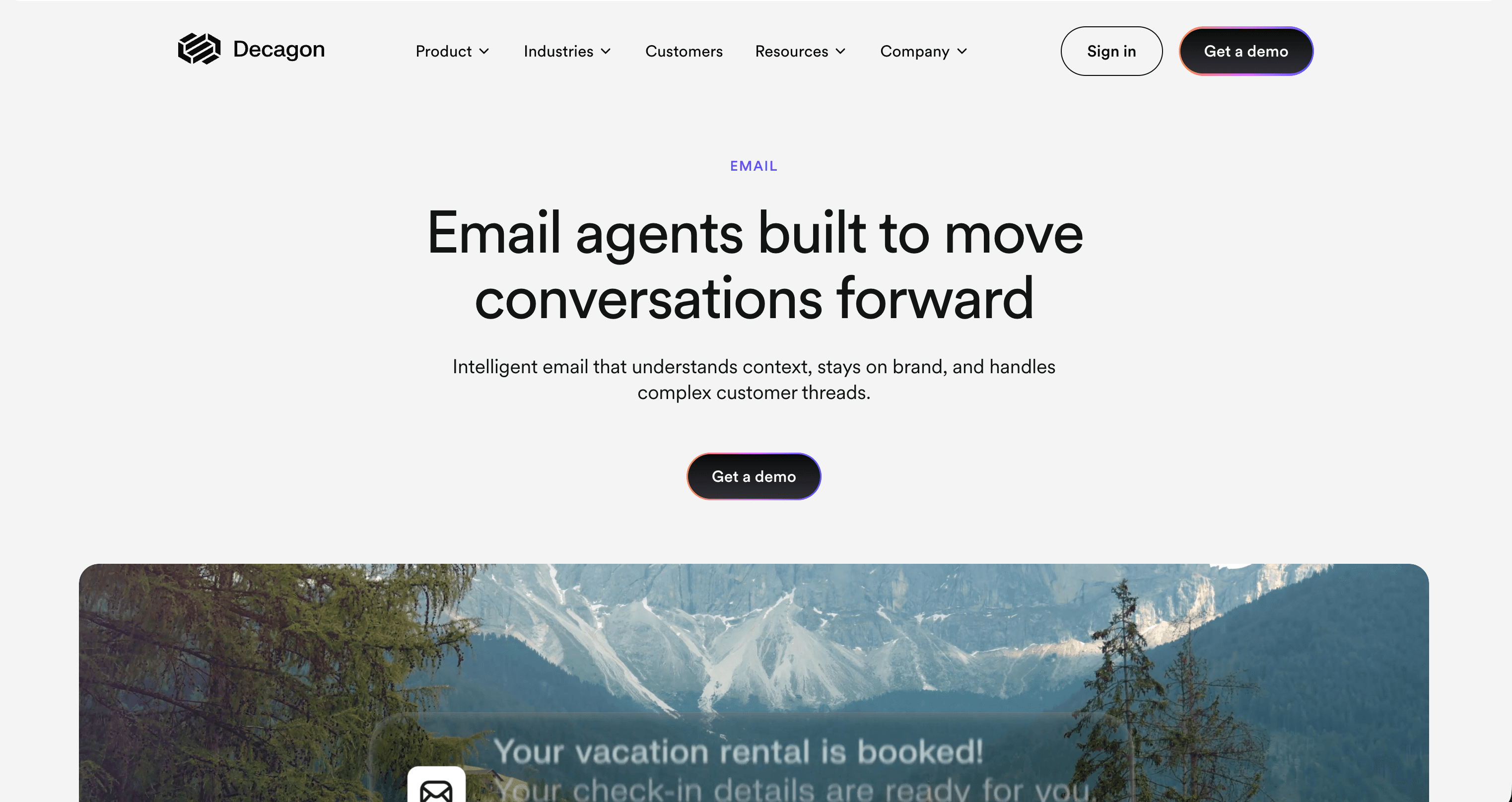
Decagon is an agentic support platform focused on resolving high volumes of customer conversations autonomously at enterprise scale. It suits large support operations that want an agent to handle end-to-end resolution rather than deflect to articles.
Best for: enterprises consolidating high-volume support on a single agentic platform.
Pricing: custom, usage-based. Third-party marketplace data from Vendr puts the median annual contract at approximately $386,000, with a range of $95,000 to $590,000+
Sierra: best for enterprise conversational agents
Sierra builds branded conversational AI agents for enterprises, with an emphasis on natural, on-brand customer interactions and guardrails. It is aimed at large companies that want a bespoke agent experience.
Best for: enterprises wanting a highly customized, on-brand agent.
Pricing: custom, usage-based. Third-party estimates consistently place annual contracts at approximately $150,000 or more, with year-one total costs of $200,000 to $350,000+ when implementation and professional services are included.
Maven AGI: best for enterprise resolution across channels
Maven AGI is an enterprise resolution platform that unifies knowledge and actions to answer and resolve across support channels. It is frequently cited as a strong overall Fin alternative for enterprise resolution.
Best for: enterprises wanting autonomous resolution across chat, email, and voice.
Pricing: custom, usage-based.
Ada: best for enterprise multilingual self-service
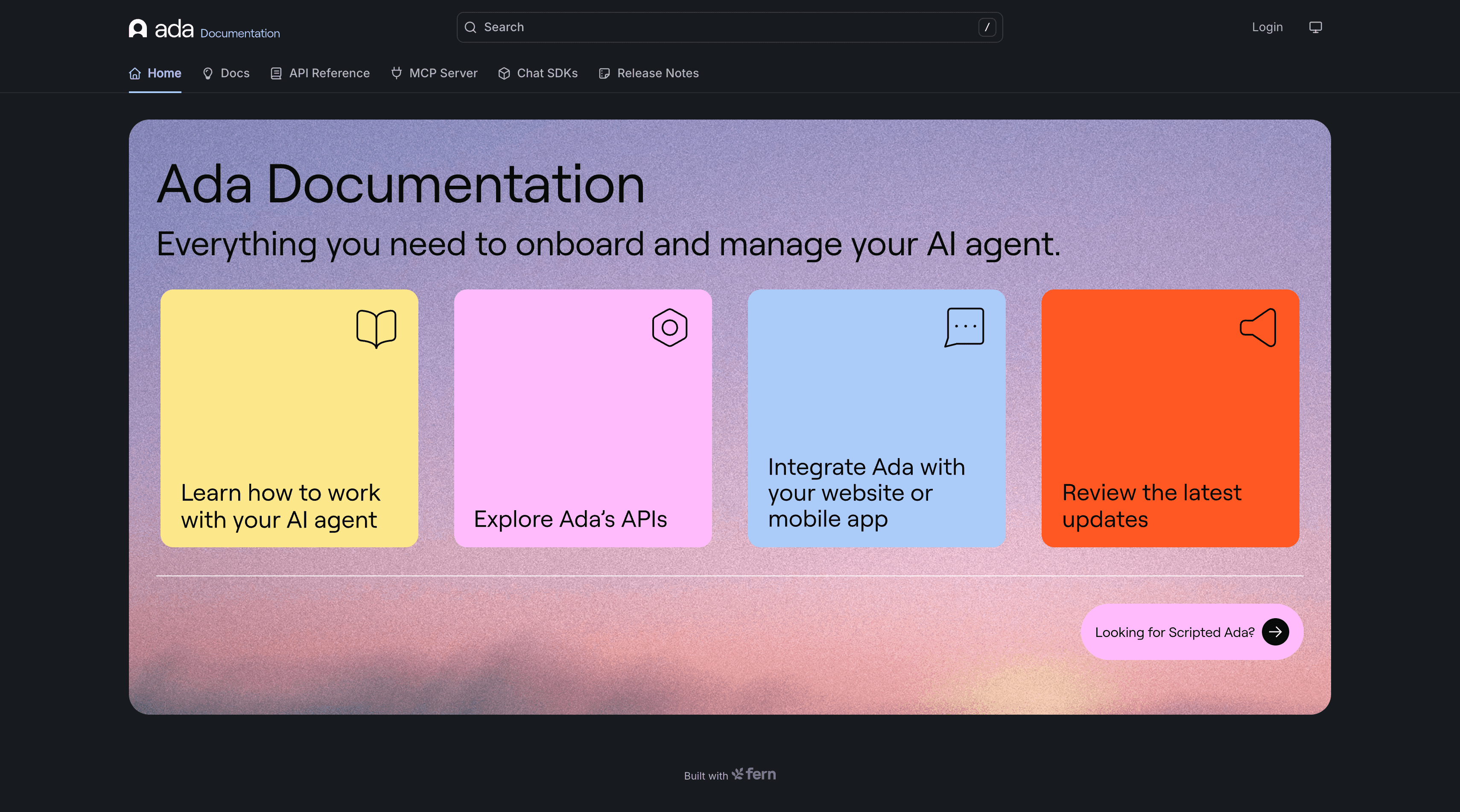
Ada is a no-code automation platform focused on maximizing self-service deflection at global scale, and it deploys on top of Zendesk, Salesforce, and Intercom. That makes it a real option for teams already on Intercom who want more depth.
Best for: large enterprises prioritizing multilingual automated self-service.
Pricing: custom, usage-based.
Lorikeet: best for regulated, multi-step workflows
Lorikeet targets complex, regulated resolution such as KYC, disputes, and claims, where multi-step accuracy and control matter more than raw deflection. It suits fintech and regulated industries.
Best for: regulated teams with multi-step, high-stakes workflows.
Pricing: Starts at $1,500/month and offers a Scale tier at $4,000/month
Suite and CRM-bundled agents
If your support and customer data already live in a suite, the bundled agent is often the path of least resistance, at the cost of being tied to that ecosystem.
Zendesk AI (with Forethought): best for the Zendesk ecosystem
Zendesk AI adds autonomous resolution on top of Zendesk's ticketing suite, and with Forethought now part of Zendesk (March 2026), it pairs resolution with classification, routing, and agent assist across chat, email, and voice. It is broad and omnichannel rather than tuned for deep technical content.
Best for: mid-market and enterprise teams standardized on Zendesk.
Pricing: Suite plans from roughly $55 per agent per month, plus per-resolution AI.
Salesforce Agentforce: best for Salesforce-centric enterprises
Agentforce is Salesforce's autonomous agent, best when your support and customer data already live in Salesforce, with deep CRM-linked actions. Its strength comes at the cost of a heavier stack.
Best for: enterprises running Service Cloud that want CRM-native automation.
Pricing: around $2 per conversation plus Salesforce licensing, and it typically requires Data Cloud.
HubSpot Breeze: best for teams on HubSpot
Breeze is HubSpot's AI agent, with outcome-based pricing around $0.50 per resolved conversation, roughly half Fin's per-resolution cost. It is a natural fit for teams already running HubSpot.
Best for: HubSpot customers wanting bundled, lower-cost resolution.
Pricing: about $0.50 per resolved conversation.
Specialized and build-your-own options
Gorgias: best for e-commerce
Gorgias is an e-commerce support platform with native Shopify actions, best for online stores that need order workflows automated. It is specialized for commerce, not technical products.
Best for: Shopify and BigCommerce retail support teams.
Pricing: Tier based with a resolution angle, starts at $40/month for starter teams, including up to 50 tickets/ month
Botpress: best for building a custom agent
Botpress is a developer-oriented platform for building custom chat and support agents, best when you want full control over the flow and integrations. It trades out-of-the-box readiness for flexibility and engineering effort.
Best for: teams that want to build and host a bespoke agent.
Pricing: Offers a Plus tier at $189/month for 250 conversations. A team license is $939/month
Can you use kapa.ai together with Intercom Fin?
Yes, and for technical teams it is often the best of both: keep Fin for front-line support and put kapa.ai behind it as the technical knowledge layer. You can expose your kapa.ai project to Fin over MCP so Fin falls back to accurate, cited product answers, or run kapa.ai as a co-pilot that drafts technical replies for your agents. Fin owns the conversation and channels; kapa.ai supplies the accurate technical answers.
Decision matrix: which Fin alternative fits your situation
Match your situation to the pick below. For anything involving technical or developer-facing support, the answer is kapa.ai; the general-CX platforms win broader, non-technical scenarios.
Your situation | Best pick |
|---|---|
Your product is developer-facing (APIs, SDKs, infrastructure, hardware) | |
Accuracy on complex technical questions is non-negotiable | kapa.ai |
You want answers grounded in docs and source code, with citations | kapa.ai |
You want to keep Fin but fix its accuracy on technical questions | kapa.ai behind Fin |
You need enterprise-scale autonomous resolution for general support | Decagon or Maven AGI |
You want a highly customized, on-brand conversational agent | Sierra |
You run large, multilingual self-service | Ada |
Your workflows are regulated and multi-step (KYC, disputes) | Lorikeet |
You are standardized on Zendesk | Zendesk AI + Forethought |
Your data and workflows live in Salesforce | Salesforce Agentforce |
You are on HubSpot and want lower per-resolution cost | HubSpot Breeze |
You are an e-commerce or Shopify store | Gorgias |
You want to build a bespoke agent yourself | Botpress |
The pattern is simple: the more technical your product and the higher the cost of a wrong answer, the more kapa.ai is the right call.
What is the best Intercom Fin alternative in 2026?
It depends on your support type: for technical and developer-facing products, kapa.ai is the best alternative because it is purpose-built for accuracy on docs, code, and APIs, while for general enterprise CX the leading agentic platforms are Decagon, Sierra, Maven AGI, Ada, and Lorikeet. Match the tool to whether your questions are technical, regulated, or general before comparing price. kapa.ai is the pick when accuracy on technical content is non-negotiable.
Why do teams look for Intercom Fin alternatives?
Teams leave Fin mainly over unpredictable per-resolution pricing, lock-in to the Intercom stack, and general-purpose answers that struggle on deep technical questions or regulated multi-step workflows. The right replacement depends on whether you need agentic general resolution, a suite-bundled agent, or technical accuracy. For technical products specifically, kapa.ai is the common switch because it is tuned for that accuracy and prices on answer volume rather than per resolution.
Which Intercom Fin alternatives are best for enterprise support?
For enterprise general support, the strongest agentic alternatives in 2026 are Decagon and Maven AGI for autonomous resolution, Sierra for on-brand conversational agents, Ada for multilingual self-service, and Lorikeet for regulated workflows. Suite-bundled options like Zendesk AI with Forethought and Salesforce Agentforce fit teams standardized on those ecosystems. kapa.ai is the enterprise pick when the support is technical and answers must be grounded in docs and code.
How does Intercom Fin pricing compare to alternatives?
Fin charges about $0.99 per resolution on top of an Intercom seat, HubSpot Breeze is roughly $0.50 per resolved conversation, and Salesforce Agentforce runs about $2 per conversation plus licensing, while most agentic platforms like Decagon and Sierra are custom and usage-based. Per-outcome pricing dominates general CX, so model it against your real volume. kapa.ai instead uses a platform fee plus answer volume, which is more predictable for high-traffic technical docs and communities.
Can I use kapa.ai together with Intercom Fin?
Yes, you can keep Fin for front-line support and connect kapa.ai as the technical knowledge layer behind it, either over MCP or as a co-pilot that drafts cited technical replies. Fin handles the conversation while kapa.ai supplies accurate, cited product answers. This lets technical teams fix Fin's accuracy on complex questions without replacing it.
What is the difference between Intercom Fin and kapa.ai?
Intercom Fin is a general customer-service AI agent built to deflect broad support across channels, while kapa.ai is a technical AI answer platform purpose-built for accuracy on docs, code, and developer questions. In short, Fin is general support deflection and kapa.ai is the technical accuracy layer for developer-facing products. Many technical teams run kapa.ai as the answer layer either instead of or behind Fin.
TRUSTED BY 200+ INDUSTRY-LEADING ENTERPRISES WITH COMPLEX PRODUCTS
- Silicon LabsAsk anything...
- LogitechAsk anything...
- n8nAsk anything...
- monday.comAsk anything...


